


The Cost of Using Cheap or Old Walkies

Budget Radios Create More Problems Than Solutions
When most people think of two-way radios the things that come to mind are police, emergency services, construction workers, and security guards. What many don't know is that walkie-talkies are used daily in grocery stores, hotels, medical offices, car washes, restaurants, schools, animal hospitals and many other industries. On a daily basis millions of Americans power on their walkie at the start of their day, wire up their earpiece, and then have the simplicity of one-button communication available to them through their entire shift. You're here because you've already made this discovery. You had the savvy to see the potential in your team using two-way radios to communicate instantly leading to increases in productivity and efficiency, and you transformed your facility's workflow for the better. What many folks don't figure out as they go is that using consumer walkies instead of industrial units, or old worn-out radios, can silently negate the time and money saved by these devices. Let's hit on some bullet points as to why that is.
Cheap Radios from that Massive Online Retailer
We're not going to invoke their name, but you know who we're referring to. It's a great marketplace with tons of cool stuff for reasonable prices and fast shipping. We all use it, and there is nothing wrong with that, they've got some good stuff in their warehouses. What they don't have is a good two-way radio. The brands available there are great for the frugal minded individual who needs radios to talk to their buddies at the concert, or the ham radio geek that needs a set of cost-effective units to futz around with. What they are not so great for is use in a business. Like with many things, you get what you pay for, and professional gear is rarely "cheap". These consumer devices cost next to nothing to manufacture, which is why they are so inexpensive to you. You're running a professional business, why equip it with what equates to a kid's toy? Here are the pitfalls of using budget walkies:
Audio Quality
Audio quality in consumer radios is abysmal at best. Tinny, ear piercing, and often hard to understand. Many users have complained about having to constantly repeat themselves, which is fine on a rare occasion, but it can become taxing if you're doing it every other call day-in and day-out. Business class radios eliminate 99% of this issue; rarely does a user repeat themselves on a business class walkie. That simple fact alone makes consumer radios not worth the small price they charge, because you're not getting what you're after: saved time. You're not buying radios, you're buying efficiency, productivity... the goal is to buy time at a heavily discounted price. If you must repeat yourself you might as well drop everything you're doing and physically track down the person you're talking to.
Budget Earpieces
Consumer earpieces don't just sound bad, they break very easily. They use wires that are not designed for longevity, lacking the strength and durability required for them to last. They're designed to function and make a sale, what happens after that is not the manufacturer's concern unless it costs them money. Sadly, the lion's share of customers say, "this is junk" and throw it in the trash and eat the $10 loss, so the most cost-effective thing for many manufacturers to do is to not care about the needs of the customer beyond the sale.
Industrial quality earpieces will sound great, offer maximum comfort, have stapled strain relief, and top-level earpieces will employ Kevlar reinforced wiring. You can go through ten $10 earpieces in a year and burn through $100, spin your wheels replacing them and waiting for them to arrive, or you can spend half that on one earpiece that will last years.
Privacy and Legal Compliance
Consumer radios tend to have common frequencies and quiet tones, known as FRS and GMRS frequencies that are illegal to use for business, reserved by the FCC for the average citizen hiking or a family outing. Anyone can buy the same or similar radios you have and sit outside listening and cutting in. You'll have better privacy and less interruption on a business class unit.
If you step up to digital radios (DMR), which are unavailable on the above marketplace, it can even employ encryption that will make it impossible to listen in without the encryption key. Most businesses want their communication to be private (or must comply with HIPAA!) and no one wants random transmissions cutting into their system when they're trying to work and communicate. Business class radios solve all of those problems.
Range
All FRS radios are 0.5 watts and will not properly cover a reasonably sized office or facility. Many consumer walkies advertise 2 or more watts, but in the realm of budget this does not always indicate good range. The radio merely needs to output 2-watts of power for the manufacturer to put that in print. It does not necessarily mean that the radio has been optimized for that 2-watts to reach it's maximum potential. You'll often find a $20 2-watt radio cannot compete with the range of a $200 2-watt radio. For instance, maybe the radio has a 2-watt transmitter, but what receiver is it using? That 2-watt transmitter isn't terribly useful if the receiver at the other end is the cheapest one they could source for the walkie, it may be less sensitive and not pick up on the outer zone of the coverage area. Lower quality antennas, lower quality circuitry; many factors are going to affect range, not just power.
When we get into professional level units, you can count on them using a proper receiver that maximizes the functionality of the 2-watt transmitter and circuitry that supports that goal. Professional walkie manufacturers tend to have a reputation to uphold because they have served specific industries for decades, and the quality of the functionality speaks for their brand and creates customer loyalty.
Durability
This is a big one. If the radios are not durable, you're going to be replacing them faster than you can get any real productivity out of them. Businesses are very hard on walkies. They are being used 8-12 hours a day, 5-7 days a week. Consumer radios were not at all designed for that, they're for a few hours at the zoo, or a single day hiking excursion. Remember about the earpieces, these are designed to make a sale and nothing beyond that. No one on the development team, no one on the design team, no one on the manufacturing floor ever thought about whether their customers would be still using them 3 years after purchase. The only thing they thought of was "how can we make this as absolutely cheap as possible yet still functional?" They likely come with a 1- or 2-year warranty that covers defects to make you feel like you're covered, but you'll never actually be able to prove any defects or issues are their fault, and they're counting on it.
Durability extends beyond "toughness", too. What capacitors were used? What resistors were used? Where did they source their audio jacks from? If the internal parts are not durable in addition to the chassis, then the radio will quickly fail from basic, normal usage. It cannot be stressed enough: reputable radio manufacturers should be your go-to for long-term equipment that will save your business time.
Old Radios That You Hesitate to Replace
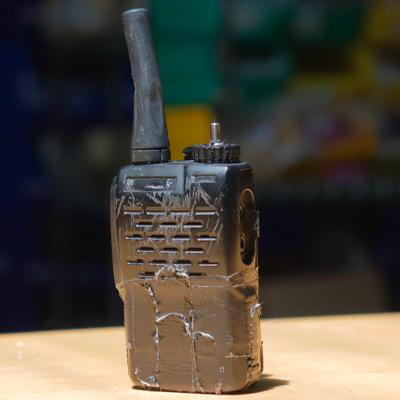
"But it still works!"
We've all been in a position where we need to replace something, look at the price, and decide to stretch our money and try our luck by making the thing work as well as we can for as long as we can before giving up and replacing it. In everyday life it's just something we do to save money, but for a business using walkies in a professional setting this can be frowned upon by the customers, clients, or patients, not to mention that it can also have a negative impact on your daily communication. This can lead to costly errors, as well as slow everyone down, reducing productivity, thereby negating the point of using them.
Unnoticed Performance Decay
Circuitry begins to fail with time. Capacitors don't hold the charge they used to. Dust gets inside and slowly accumulates, resulting in more heat and less efficiency. Resistors start exhibiting resistance drift due to age. Knobs wear out, become crackly, or only work barely well enough to justify keeping the radio in service, and slow the user down.
5-7 years is the maximum recommended usage of a two-way radio in a business setting. It's around that mark that the returns diminish due to slowly dying circuitry, and dealing with walkie issues eats up all of the time the radios have previously been saving. Many of these issues are practically invisible, and because they happen so slowly over time they go unnoticed. Almost never do radios get replaced because someone made a smart decision, it primarily happens when a radio fails on a super busy day and the team's communication is hindered until the new replacements arrive. Avoid that nightmare day and replace before the radio is a problem.
Long-Term Battery Life
If we could change physics the world would be different, but batteries don't last forever. As time goes on the battery holds less and less of a charge, until it eventually holds none. Batteries will generally cost 1/4 of the total cost of a replacement walkie. Replacing them once is fine, but if you replace the battery a second time you've now spent half of what it would cost to just replace the radio. If you replace the batteries 4 times you've bought a new radio with all new circuitry that you never got to use. The sweet spot is to replace the battery one time, and then replace the walkie when that battery dies. Batteries should last a minimum of 1 year, but 2-3 years is not unheard of. On a good radio, this should give you 4-6 years of good, solid service from a two-way radio, and since 5-7 is the mark for recommended replacement, failure of the second battery is the perfect marker to remind you it's time to replace the walkie.
Structural/Mechanical Weaknesses
As time goes on materials can break down. A radio with a durable aluminum chassis will hold up for a long time, but eventually the plastics and other materials used in the manufacturing process become weaker and easier to break or wear out. The plastics in the knobs, antenna and housing aren't as durable as they were when the radio was purchased. The mechanical parts, such as the knob internals, become weaker and the "wear and tear" begins to accelerate. Though difficult to notice, the walkie's returns begin to diminish. The trick is to try to replace it prior to that point, before it starts creating more problems than it's solving.
Silent Hardware and Firmware Revisions
Oftentimes a manufacturer makes unannounced small changes to a product to improve it, especially in electronics. They can switch to higher quality capacitors or maybe found that a certain transmitter works better than another so they swapped, or maybe they found a minor and hardly noticeable fault in the firmware and corrected it. The electronics we use every day get changed regularly without us knowing, and the only way to tell is to take it apart or dissect what information is saved on the chips. When a user decides to replace a unit, they are often getting improvements that they may not even know about, and maybe even still won't notice. Sometimes, users will say a certain unit seems better than others, but they can't explain why. Tiny incremental improvements happen that the team may sense but not consciously take notice of.
Now You Know!
As you can see, there is a hidden cost to using budget radios or trying to stretch old ones beyond their limit. The time consumed solving issues, the time lost repeating yourself or futzing with the unit to get it working, the money lost on replacement radios and earpieces. How about the time you called John at the other end of the building, and he didn't respond because your radio no longer transmits and you don't know that he didn't hear you? Time wasted. Implementing common-sense practices for replacing old units and keeping consumer walkies out of your business will keep your company in a position to maximize the true benefits of wireless push-to-talk communication!