


Choosing the Right Walkie-Talkies for Your Animal Hospital
Picking the Right Wireless Veterinary Office Communication System is Challenging
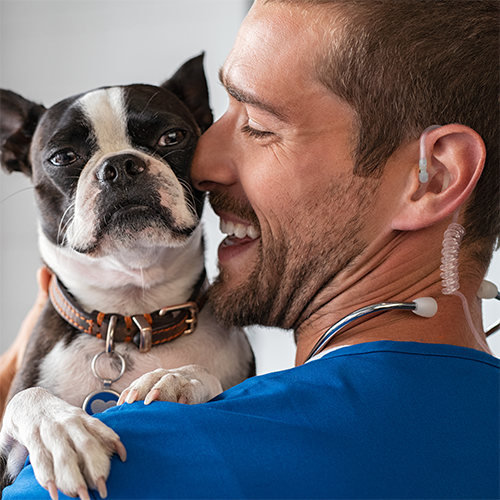
There are many different walkie-talkie manufacturers providing myriad choices in terms of two-way radio communication for veterinary practices in this day and age. Today, we'd like to give you some pointers as to what to look for and how to make a final decision as far as what product you ultimately purchase and implement in your facility. In the end, a two-way radio system should provide a list of benefits and bring as few new problems to the table as possible. No matter what, when new equipment is implemented in a business it comes with new issues, such as cleaning or maintenance. Walkie-Talkies should provide far more benefits than drawbacks, and the below information will give you the wherewithal to find a product that will do just that in your animal hospital.
The Cost of Adding an Animal Hospital Walkie-Talkie System
Generally speaking, you will find that "big-box" store walkies are cheaper. Yes, they cost substantially less per unit, or in batches on the initial purchase. However, a study by Gartner showed that these "cheap" two-way radios actually cost 25% to 50% higher than proper professional walkies over the course of a 3 year period. This is due to the poor build quality of these units, which are mass manufactured as cheaply and quickly as possible. They have a very high failure rate, and Gartner's study showed that when one failed the company lost up to 80 minutes of productivity, and on average 2.5 hours of support time. These radios were simply not designed for a full shift of use 5 days a week in a veterinary office setting. Those hours add up over the course of a year and the wear and tear can run up a bill, especially in the more rugged environment of pet oriented businesses. The reality is that an enterprise-grade two-way radio is the best choice because it was specifically designed to be used heavily day-in and day-out. Every veterinary office will benefit the most in the long run by avoiding these cheaply made units that were intended for families going to the zoo or kids on skateboards.
Durability and Features Define the Best Walkie-Talkies for Your Animal Hospital
As said before, the cheaper walkie-talkies cost animal hospitals more money and time in the long-term, so durability is an important consideration. Features matter, too. Here are things we look for in terms of quality and feature-sets:
-
Business Class Frequencies
- Avoid the term "FRS" (Family Radio Service) at all costs, this is what you see for sale at the department store. These radios use frequencies the FCC set aside for the average person to use, and are limited in wattage. That means any joker teenager can buy the same (or any FRS) radios you bought and sit outside your facility listening in and interfering in your communications, negatively impacting your workflow.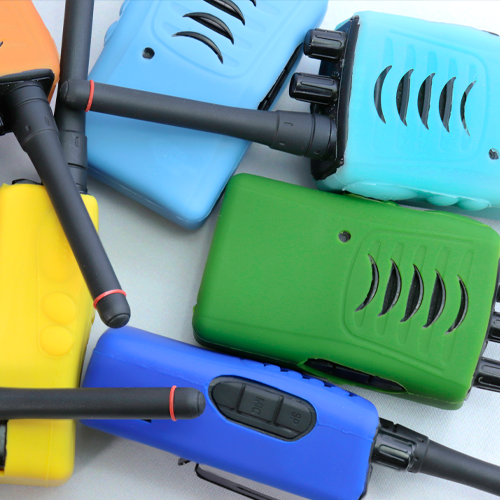
-
No Less Than 4 Watts of Power
- The more power, the bigger the range. Most practices are fine at 4 watts. An FRS radio is limited to 0.5 watts on half of the channels, not remotely enough to ensure messages are travelling across the building, through walls, and past medical equipment that may output radio waves. Larger animal hospitals may need to bump up to 5 watts for full coverage. -
Radios Should Have an Aluminum Chassis
- Plastic flexes, plastic breaks, an aluminum chassis keeps a radio tough and rigid. The veterinary industry is one of the places where this is profoundly important. -
IP55/IP65
- A rating in this range will mean less water and dust can get in, lending to the lifetime of the equipment. Another feature that is paramount to an animal hospital. -
Earpieces Should Use Coiled Tubes and Semi-Custom Earmolds
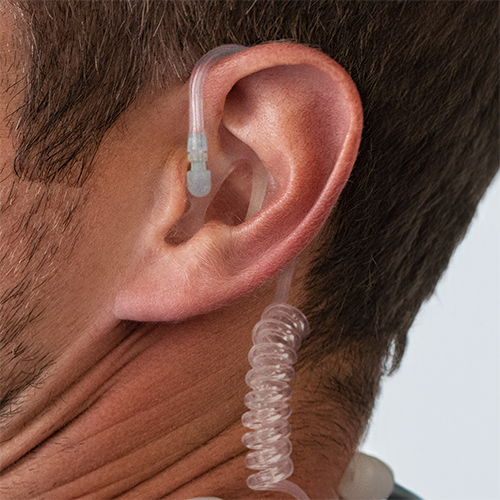
- This is by far the most comfortable option. The coiled tube/semi-custom option can be worn for up to 12 hours without fuss. Your provider should also have choices for the rare teammate that prefers an earhook or other solution. -
Earpieces Should Be Kevlar Reinforced
- This is why many earpieces fail in the first 6-12 months, the wire is just not durable and it breaks. In an animal hospital the wire should be worn under clothing to prevent animals snagging it, but in the event that they do you want a wire that can take the abuse.
-
Earpieces Should Have Stapled Connections
- A common point of failure on any electronics with wires is where the wire connects to different parts, like the mic or the speaker. This is where the most stress is applied when pulled or yanked, being stapled will almost eliminate the chance of breakage at a connection point. -
Earpieces Should Allow Talking Without Contaminating
- Veterinary teammates will have to press a button to talk, and changing gloves to send a message is a huge inconvenience in some scenarios and wastes time and supplies. Look for earpieces with a large enough button that it can be pressed with the inside of the wrist to avoid contamination or changing gloves. -
Cases With Colors Should Be Available
- They're not just for protection, different colored cases allow quick differentiation between units, if all units are black they are likely indistinguishable from each other. They can be labeled, but if the entire radio is red it takes less than 1 second to determine who's it is or where it belongs. -
Warranty
- Look for a warranty that covers damage in addition to manufacturer's defects, you're in an animal hospital! Most cover defects for 1-2 years, if it can be determined why the failure occurred and that failure can be proven to be the manufacturer's fault. A truly good warranty will involve the term "no questions asked" and will replace a radio even if it was dropped off of a building. The cause of failure won't matter to your provider, but whether or not you have a working radio will be of great importance to them.
Following these points all but guarantees that you will set yourself and your team up for success by carefully choosing a product that will meet the rigorous requirements of hours of every day use in a pet-oriented environment.
Choose a Provider that Cares About You and Your Practice

The massive corporations of the world have given up on customer service. In this day and age, if a company even provides over-the-phone support it's often the case that the team who answers the phones is outsourced, and actually knows nothing about two-way radios. They receive minimal training, and are instructed to go off of guides and troubleshooting documents, the same ones you can probably find on your own online. Look for a company that does provide over-the-phone live support with real human beings that have the authority and skill to genuinely troubleshoot and request replacements. This can often be determined by calling in and checking for an electronic phone menu. Look for a company that doesn't have one, where a person just answers the phone and talks to you rather than a computer system trying to solve your problem before allowing you to speak to someone. If a computer answers, it's obvious they care more about their own efficiency than the efficiency that their customers are trying to achieve with their walkies.
You've Got What You Need
Now that you've read this article, you are armed with more than enough information to make the most informed decision about what Animal Hospital Communication System is going to maximize the efficiency and budget in your animal hospital. We hope that this article provided you with the information you were after, but if you still have questions about using walkie-talkies in animal hospitals we are more than happy to help. Our phones are answered by humans, and we will happily answer your questions with no pressure to buy anything, we are here to help you with your communication needs, even if it's just answering a few questions!
Best of luck to your animal hospital, may your communication be clear and your veterinary practice prosper!